Learn to fly a plane: the 7 stages between your first lesson and your first solo
Learning to fly a plane follows a set order: the four fundamentals, then slow flight and stalls, then the traffic pattern and landings, then emergencies, and then your first solo. Most students solo somewhere between 15 and 25 hours. Here is each stage as it happens at Page Field, and what you will be able to do at the end of it.
By Cristian Duran
People imagine learning to fly as one huge skill. It is really a stack of small ones, learned in a deliberate order, each built on the last. Nobody lands the airplane on their first lesson, and nobody is expected to. By the time you solo, though, you will have practiced every piece of it so many times that it feels routine.
Here is the order, as it happens at Core Aviator Training at Page Field (KFMY).
Stage 1: Your first flight
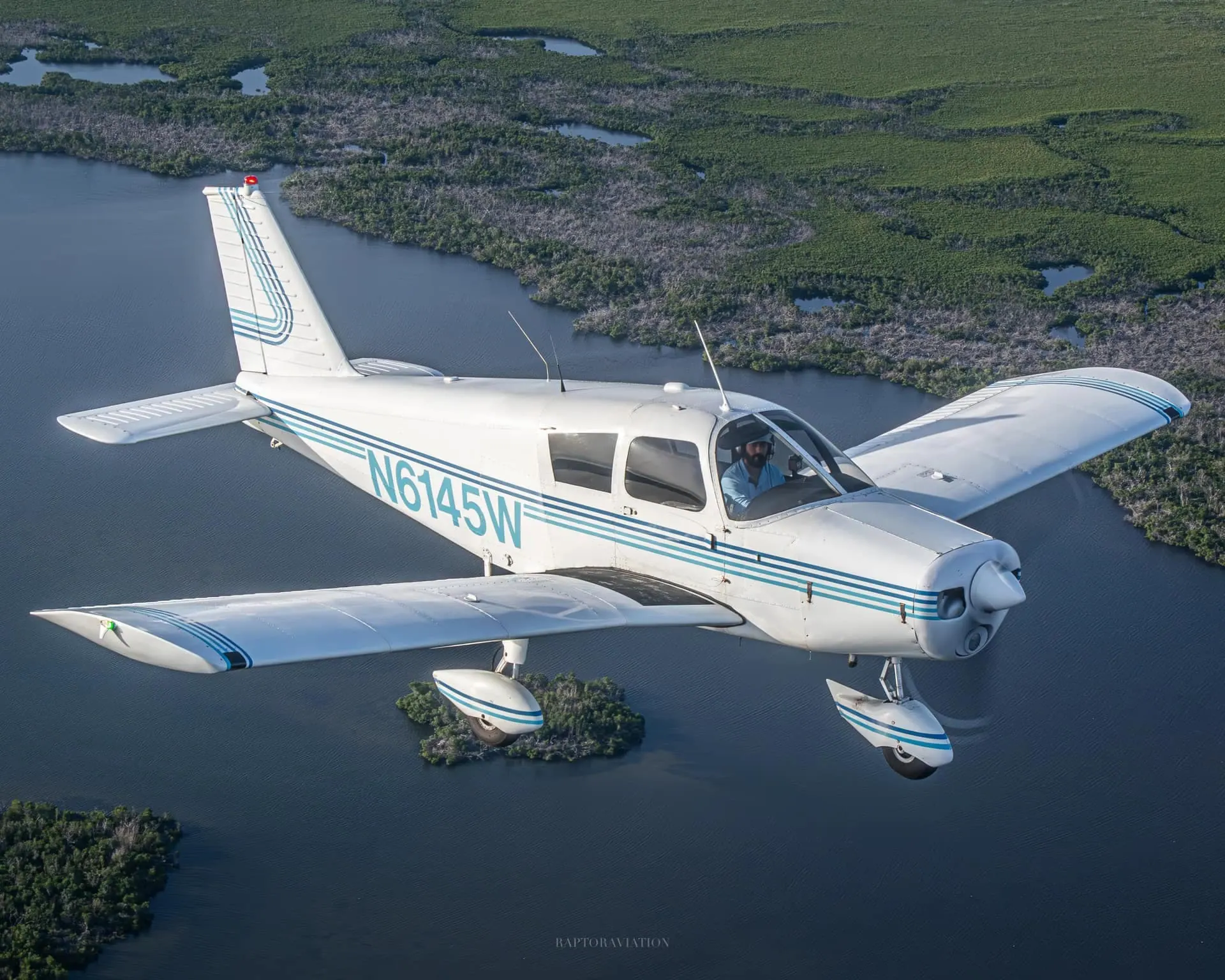
Your first lesson is a Discovery Flight. We brief at the table, do the walk-around together, and you sit in the left seat — the pilot’s seat. You steer the Cherokee to the runway with your feet, and once we are airborne you fly it: gentle turns, a climb, a descent, over the Caloosahatchee and the Gulf coast.
You will be surprised how light the controls feel, and how much of flying is looking out of the window. It goes in your logbook and counts toward your 40 hours. More detail in what actually happens on a Discovery Flight.
Stage 2: The four fundamentals
Every maneuver you will ever fly is built from four things: straight and level, climbs, descents and turns. The first few lessons are about doing them well — holding an altitude, rolling into a turn and out of it on a heading, setting power and attitude for a climb.
The key lesson here is that pilots fly by attitude — where the nose sits against the horizon — and use the instruments to confirm it. Students who stare at the instruments chase the needles. Students who look outside fly smoothly.
Stage 3: Slow flight and stalls
Next comes the low-speed end of the envelope. In slow flight you fly the airplane just above the speed where the wing stops working, and learn how the controls feel soft and sluggish there. Then stalls: you deliberately exceed the wing’s critical angle, feel the airplane tell you, and recover.
This is the stage people dread and then find fascinating. Stalls in a Cherokee are gentle and predictable, and once you understand why they happen, they stop being frightening. They are also the most important safety skill you will learn.
Stage 4: Ground reference maneuvers
Turns around a point, rectangular courses and S-turns teach you to fly a precise path over the ground while the wind pushes you around. They are the foundation of the traffic pattern. Over Southwest Florida’s grid of roads and canals, there is never a shortage of references.
Stage 5: The pattern and landings
Now the airplane comes back to the runway, again and again. You fly the traffic pattern at Page Field — talking to the tower on every circuit — and practice takeoffs and landings, including crosswind landings, go-arounds and short- and soft-field technique.
Landings are where everyone slows down for a while. That is normal. One day the flare suddenly makes sense, and after that it gets better quickly. If the workload in the pattern feels like too much at first, it happens to every student — read what to do when the airplane gets ahead of you.
Stage 6: Emergencies
Before you solo, you practice what to do when something goes wrong: an engine failure after takeoff, an engine failure at altitude, a fire, an electrical failure, a go-around when the runway is not clear. You will fly simulated engine-out approaches until picking a field and setting up the glide is automatic. Florida’s flat terrain helps: there is almost always somewhere to put the airplane down.
Stage 7: Your first solo
When you are flying the pattern safely and consistently, handling emergencies, and making sound decisions on your own, I sign you off. You need three things in place first:
- An FAA medical certificate and a student pilot certificate
- A pre-solo knowledge test, which I give you and we go over together
- Logbook endorsements for your solo
Then I get out of the airplane, and you fly three takeoffs and landings by yourself at Page Field, with the tower talking to you and me watching from the ground. Most students solo somewhere between 15 and 25 hours. How often you fly matters more than anything else in getting there.
It is the best day in flight training. Nobody forgets it.
After solo
Solo is about halfway. After it come navigation, cross-country flights to other airports, night flying, flight by reference to instruments, the FAA written and finally the checkride. The full path to your certificate is in how to become a pilot.
How long it takes to learn to fly a plane
The FAA minimum for a Private Pilot License is 40 hours. Students who study their ground material typically reach checkride standard around 65. The single biggest factor in where you land is frequency: fly twice a week and every lesson builds on the last.
What it costs
The Cherokee 140 is $190 per hour wet and instruction is $60 per hour, paid as you fly. Getting to solo usually costs roughly $4,250–$7,000 in airplane and instruction; the whole certificate is broken down in pilot training cost in Fort Myers.
Learn to fly at Page Field
Start where every pilot starts: one flight. A Discovery Flight is $175, flown by you from the left seat, and logged toward your certificate. Call 239-722-6751 and ask about the next opening.