How to become a pilot in Southwest Florida: the 8 steps, in order
To become a pilot you fly a first lesson, get an FAA medical and a student pilot certificate, train toward solo, pass the FAA written test, and then pass a checkride with an examiner. At Page Field in Fort Myers that takes most students a few months of consistent flying and around 65 hours. Here is every step, in order.
By Cristian Duran
Becoming a pilot is a sequence, not a mystery. Every private pilot in the country went through the same steps, in roughly the same order, and the FAA publishes every requirement. What the regulations do not tell you is what each step actually feels like, how long it takes, and where people get stuck. That is what this guide is for.
It is written for someone starting from zero in Fort Myers, Cape Coral, Naples or anywhere in Southwest Florida, and it covers the path to a Private Pilot License — the certificate every other rating is built on.
The short version
- Fly a first lesson.
- Get an FAA medical certificate.
- Get your student pilot certificate.
- Learn to fly the airplane, then learn to land it.
- Fly solo.
- Learn to navigate, then fly solo cross-country.
- Pass the FAA knowledge test (the written).
- Pass the checkride.
Most students who fly consistently reach the end of that list in a few months. The FAA minimum is 40 flight hours. Our students who keep up with their ground study usually get there around 65.
Step 1: Fly a first lesson
Before you spend real money, find out whether you like it. A Discovery Flight at Page Field is $175 and runs about an hour. It is not a sightseeing ride. You do the walk-around, sit in the left seat, take off with your hands on the controls and fly the Cherokee 140 over the Caloosahatchee and the Gulf coast. The time goes in a logbook with your name on it and counts toward the 40 hours.
You do not need a medical, a student certificate or any experience to do this. You need a photo ID and shoes you can walk on a ramp in. We wrote up what actually happens on a Discovery Flight if you want to know exactly what to expect.
Step 2: Get an FAA medical certificate
You need a medical certificate before you can fly solo. For a private pilot that means a third-class medical, issued by an FAA-designated Aviation Medical Examiner (AME). There are several in Lee and Collier counties.
The process: you fill out the FAA’s MedXPress form online, book an AME, and attend a short exam covering vision, hearing, blood pressure and general health. Most people walk out with the certificate the same day.
Apply early — in your first few weeks of training, not the week before your solo. If anything in your history needs extra paperwork, you want that running in the background while you train, not holding you on the ground.
If you are worried about glasses, ADHD, a past condition or a medication, read how do I become a pilot if… before you fill in MedXPress. What goes on that form is permanent.
Step 3: Get your student pilot certificate
This one is paperwork. You apply through the FAA’s IACRA system, usually with your instructor sitting next to you, and the plastic card arrives by mail a few weeks later. You must be at least 16 to hold one for airplanes. You can take lessons before it arrives; you cannot solo without it.
Step 4: Learn to fly the airplane
The first ten or so hours are about the four fundamentals: straight and level, climbs, descents and turns. Then slow flight, stalls and stall recovery, ground reference maneuvers, and emergency procedures. None of it is as dramatic as it sounds. Stalls in a Cherokee are gentle and predictable, and by the time you practice them you will understand exactly why they happen.
Then comes the pattern: takeoffs and landings, again and again. Landings are where everyone slows down for a while, and that is normal. Because Page Field is towered, you will be talking to ground and tower through all of it. It feels like a lot for the first three lessons and then becomes automatic.
At CORE every lesson is a three-hour block: a brief at the table, the flight, and a debrief. More on how that works in flight lessons in Fort Myers.
Step 5: First solo
Your first solo is the day your instructor gets out and you fly three takeoffs and landings by yourself. You need your medical, your student certificate, a pre-solo written test your instructor gives you, and logbook endorsements saying you are ready.
Students often solo somewhere between 15 and 25 hours, and how often you fly matters more than anything else in getting there. It is the single best day in flight training, and nobody ever forgets it.
Step 6: Navigation and cross-country
After solo, the training opens up. You learn to plan a flight with a chart, a plotter and an electronic flight bag, to handle airspace, to divert, and to fly at night. The FAA requires, among other things:
- 3 hours of dual cross-country and 3 hours of night training, including a night cross-country of more than 100 nautical miles and 10 night takeoffs and landings
- 3 hours of flight by reference to instruments
- 10 hours of solo, including 5 hours of solo cross-country
- one solo cross-country of at least 150 nautical miles with full-stop landings at three airports
From Page Field, cross-country flights typically head to fields up and down the Gulf coast and inland across the state. The coastline makes navigation forgiving while you learn it.
Step 7: Pass the FAA knowledge test
The written is 60 multiple-choice questions taken at an FAA testing center, and you need 70 percent to pass. It covers regulations, weather, aerodynamics, navigation, airspace and performance. You need an instructor endorsement to sit it, and the result is valid for 24 calendar months.
Most students study with a self-paced online course plus ground school sessions, and take the test about halfway through flight training. Taking it early means the knowledge is fresh when the flying gets complex. Read the written and the checkride are two different animals for how to prepare for each.
Step 8: Pass the checkride
The checkride is your final exam, given by an FAA Designated Pilot Examiner. It has two parts: an oral exam on the ground, and a flight where you demonstrate the maneuvers and procedures in the Airman Certification Standards. Before it, you need three hours of training in the two months leading up to it, and your instructor’s endorsement.
Pass, and you walk out with a temporary Private Pilot certificate the same day.
How long it takes
| How often you fly | Typical time to checkride |
|---|---|
| Three times a week | About 3–4 months |
| Twice a week | About 4–6 months |
| Once a week | About 8–12 months |
| Less than weekly | A year or more, and more total hours |
These are planning numbers, not promises. Weather, your schedule and your study habits all move them. But the pattern holds for nearly every student: frequency is the biggest lever you have.
What it costs
At Core Aviator Training the Cherokee 140 is $190 per hour wet and instruction is $60 per hour, paid as you fly. A student finishing at the 40-hour minimum spends roughly $10,600 on airplane and instruction; one finishing around 65 hours spends closer to $17,150. Add your medical, the written, the examiner and a headset. The full worked example is in pilot training cost in Fort Myers.
How to get through faster
- Fly at least twice a week. Continuity is cheaper than repetition.
- Study before the lesson, not during it. Every hour of ground knowledge you bring from home is an hour of flying you do not pay to relearn.
- Chair-fly. Sit in a chair, close your eyes and run the checklist and the radio calls out loud. It is free and it works.
- Use the simulator for procedures. It is the cheapest hour in aviation.
- Keep one instructor. Switching costs hours every time.
After the private certificate
The private certificate is the foundation. From here you can add an Instrument Rating, go on to a Commercial Pilot License, or simply fly — to the Keys, up the coast, or across to the Atlantic side with someone in the right seat.
Questions people ask about becoming a pilot
What is the minimum age to become a pilot? You can take lessons at any age. You must be 16 to solo an airplane and 17 to earn a Private Pilot License. For a commercial certificate you must be 18.
Do I need a college degree? No. No FAA pilot certificate requires one.
Can I train part-time while I work? Yes. Most Part 61 students do. Part 61 training fits around a job; what matters is flying consistently, ideally twice a week.
Can I become a pilot if I wear glasses? Yes. Glasses and contacts are normal. We answer that and the other common worries in how do I become a pilot if…?
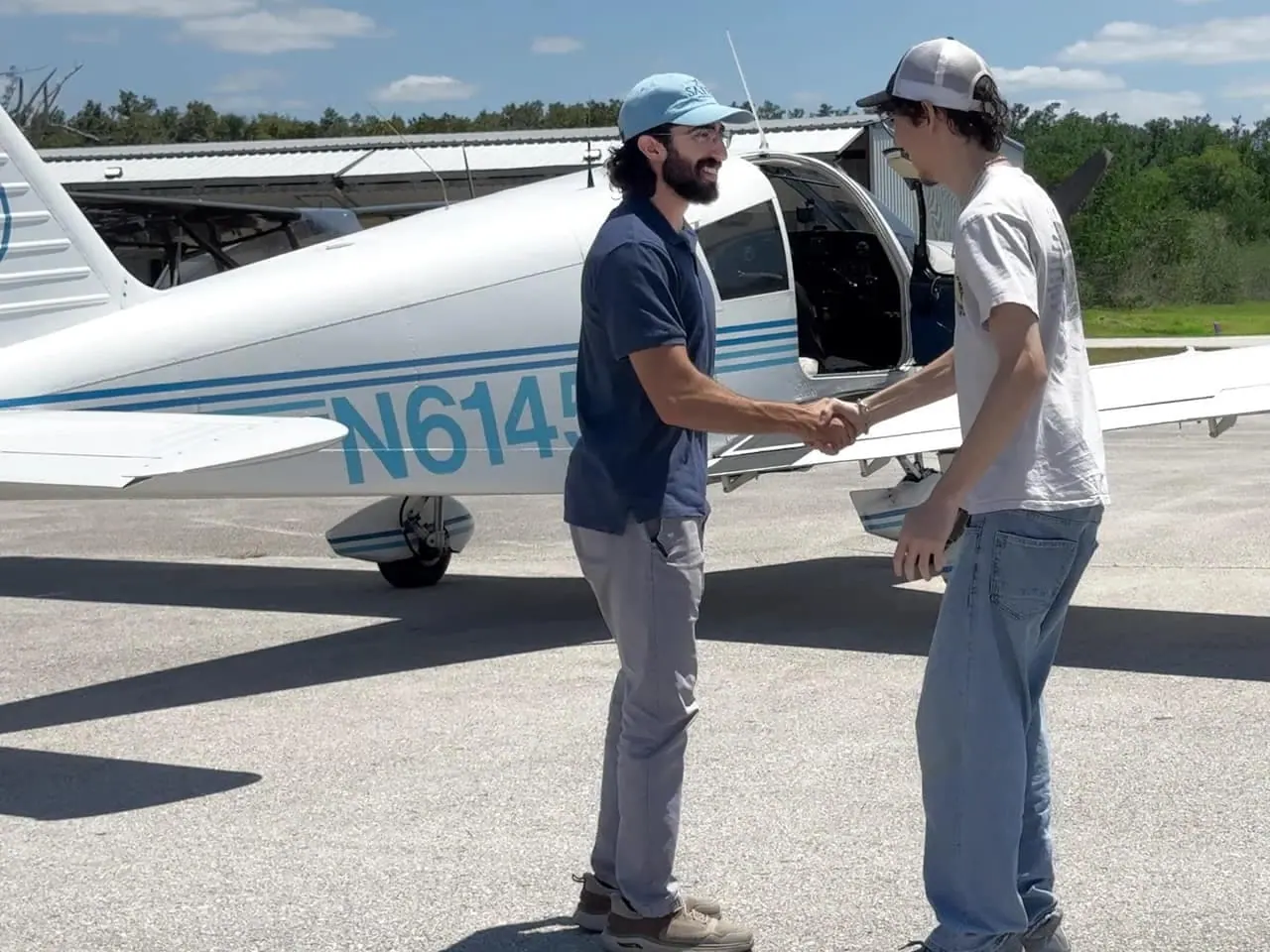
Which airplane will I learn in? At CORE, every lesson flies in N6145W, a Piper Cherokee 140 with a 150-HP Lycoming upgrade. See the fleet.
Where do I go for lessons? The General Aviation Terminal at Page Field (KFMY), 607 Danley Dr, Fort Myers, FL 33907 — a short drive from much of Lee County.
Where to start
Start with one lesson. A Discovery Flight is $175, it is flown from the left seat at Page Field, and it counts. Call 239-722-6751 and ask about the next opening.